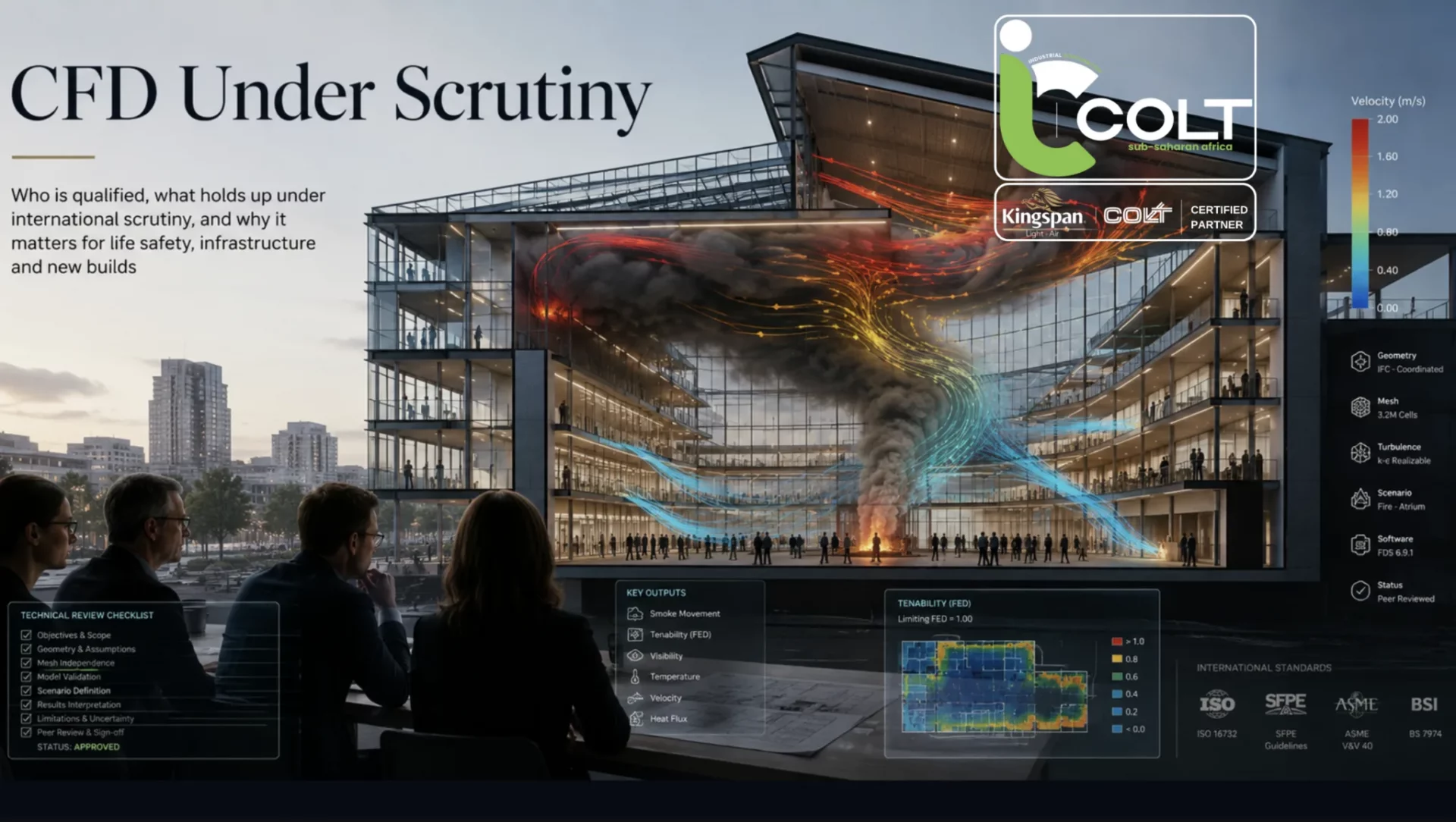
CFD modelling is one of the most powerful tools available in smoke control design. It is also one of the easiest to misunderstand, overstate or rely on without enough challenge.
Why this article matters
↳ The issue sits at the intersection of life safety, professional competence and investor confidence.
Computational Fluid Dynamics (CFD) has become one of the most talked about tools in smoke control design. In the right hands, for the right building, with the right assumptions, it is powerful. In the wrong hands it becomes a glossy justification exercise dressed up as engineering.
That is the uncomfortable conversation our industry keeps skirting around.
This is bigger than one standard, one country or one product family. If a smoke control strategy is being used on infrastructure, major refurbishments, logistics facilities, transport hubs, public buildings, student accommodation, industrial sites or high value commercial developments it should be capable of standing up to international scrutiny. It should satisfy investors, insurers, professional teams and approving authorities that the design basis is credible, transparent and fit for purpose.
That is where the real pressure begins.
CFD stands or falls on the quality of its inputs
CFD modelling earns its value through what goes into it, who prepares it, who reviews it and who signs off the result.
The sharper concern raised in discussion was this: smoke control modelling is sometimes being treated as a technical drawing exercise or a software output, when in reality it is a specialist life safety discipline that calls for highly qualified professionals, sound engineering judgement and proper challenge across the full project team.
That distinction matters.
A CFD model is only as credible as the fire scenario, geometry, ventilation logic, boundary conditions, activation assumptions, tenability criteria, sensitivity checks and interpretation behind it. It is a specialist tool that depends on competence, discipline and sound judgement.
The concern raised was that some project teams are leaning on CFD to justify smoke control strategies while sidestepping the level of specialist input, review and due diligence that such work should demand. In that same discussion, concern was also raised that approving teams may be receiving the visual outputs of a model without the full calculation trail, the rationale for the selected fire, or the detailed inputs required to interrogate whether the model reflects the real building and the intended system response.
That is where confidence starts to crack.
Why this matters to international investment and infrastructure confidence
Investors in infrastructure and new build programmes are not buying graphics. They are buying confidence.
That confidence sits in whether a design approach is bankable, insurable, reviewable and durable under scrutiny. Where projects are funded internationally, or intended to attract institutional capital, development finance, global insurers or multinational occupiers – the design language has to travel. It has to make sense beyond the local room. It has to hold up when reviewed by teams who are used to disciplined evidence, clear assumptions and documented accountability.
The methodology, the evidence and the design reasoning should be strong enough to stand in front of serious scrutiny anywhere.
Wind, roof geometry and the real world still matter
This matters even more in places where climate and site conditions are not mild, neat or forgiving.
High wind regions, exposed sites, coastal zones, complex roof forms, curved roofs, sloped roofs and large distribution spaces all change smoke behaviour and system performance. They also change what is fit for purpose.
Credible smoke control design goes far beyond “the model looked fine on screen”.
A model that ignores local wind effect, opening conditions, roof geometry, actual obstruction, sprinkler response or realistic fire growth may still produce a neat visual output. It may even win approval from a busy team that lacks the time or technical depth to interrogate it. That leaves the strategy exposed.
The conference moment that should have rung alarm bells
The broader concern in your discussion was not theoretical. It was linked to what was reportedly being said around a Cape Town industry event.
That matters because culture drives practice.
Once the mood in the room shifts from “show me the basis” to “show me something that passes”, the quality of life safety decision making starts to erode.
When municipalities, councils and approval teams are under pressure
Another point raised in the discussion deserves daylight. The concern was how councils are expected to approve CFD submissions where the model arrives without the full calculation logic and where local approving teams may not have the same interrogation capacity seen in stronger technical jurisdictions.
That concern is fair.
Approving authorities are under pressure. Programmes are rushed. Submissions arrive late. Teams are lean. Developers want answers. Contractors want movement. Consultants want sign off. Quantity surveyors want budgets to land. Main contractors want the programme protected. Professional teams want coordination to keep flowing.
That is precisely why the standard of evidence has to rise.
If a CFD model is submitted, the pack should go well beyond images, smoke layers and comfortingly coloured graphics. It should include the engineering spine of the design.
Reviewers should be able to see the design fire, the reason it was selected, the assumptions made about activation, openings, wind, occupancy, tenability, sprinklers, fuel load and geometry, the sensitivity checks that were run, the factors that could change the result, and the uncertainties that still remain.
With that backbone in place, the model earns trust. Without it, confidence falls away.
A convincing output still requires a defensible basis
One of the most telling points in the discussion was the warning that people who do not know what to challenge, may accept a model simply because it looks convincing.
That should give the entire industry pause.
Smoke control sits in the world of life safety, engineering accountability and disciplined decision making. It calls for more than branding, software ownership or a convenient workaround for weak specification.
It is life safety, in the clearest possible sense.
What good practice looks like
A stronger project approach would be refreshingly simple:
↳ Use CFD where the building genuinely requires it
↳ Ensure the modeller is competent in fire engineering, not just software use
↳ Tie the model to the real building, real geometry and real operating conditions
↳ Document assumptions in a form others can interrogate
↳ Present the design fire logic clearly
↳ Explain sprinkler interaction and activation sequences properly
↳ Show sensitivity testing, not just one favourable output
↳ Allow peer challenge before authority submission
↳ Train consultants, clients, contractors and authorities to spot weak submissions
That is the grown up version of CFD in smoke control.
Where the industry goes from here
➤ The route forward is stronger awareness, earlier scope and better scrutiny.
This is exactly why education and early project awareness matter.
There is a strong case for more open technical sessions on CFD in smoke control, especially in markets where the gap between modelling capability and approval capability is widening.
↳ That capability should be available to the industry early enough to influence scope, budgeting and design decisions, rather than being treated as an afterthought once the risk has already been priced too lightly.
The industry benefits from fewer slogans and sharper questions.
Key questions remain clear: who prepared the model, which assumptions were used, which design framework anchors it, how the fire was selected, how wind, activation or sprinkler timing could change the outcome, who has challenged it, and who is prepared to stand behind it when the building is occupied.
That is the conversation worth having.
Manufacturing to export
↳ The strongest standard is the one that holds up under scrutiny.
For infrastructure and major new builds, the strongest standard is the one that holds up under scrutiny – by authorities, insurers, investors and technical reviewers alike.
The question is rarely whether a standard exists. The real question is whether the chosen method, evidence base and approval route are strong enough to travel beyond the local room.
Closing
CFD modelling is an important tool. It also becomes a dangerous hiding place when discipline falls away.
When used properly, it supports better smoke control design in complex buildings. When used carelessly, or sold by confidence rather than competence, it becomes a polished way to take chances with human life.
That is where engineering gives way to risk dressed in better graphics.
IC Colt | Kingspan Light + Air | Colt International
Read more here: LinkedIN
EN Wisdom & Global Standards Insight
International investors rely on standards that are independently tested, system-certified, and continuously verifiable. EN standards remain a cornerstone of global life-safety assurance, yet they are not the only recognised frameworks. UL, ISO-aligned fire testing regimes and other internationally recognised standards form part of the same governance expectation.
What matters is not the label, but the discipline: full-system certification, traceable documentation and ongoing verification beyond installation.
Coming Next
➤ What should councils, consultants and clients ask before accepting a CFD based smoke control strategy?
About IC Colt (Pty) Ltd : IC Colt is the certified Sub-Saharan partner to Colt International. The company specialises in fire safety, sustainable ventilation systems, and EN-compliant solutions tailored for public infrastructure, commercial buildings, and industrial facilities.
IC Colt | Colt International | Kingspan Light + Air
???? Media inquiries: press@icorpgrp.com–